Joel Perca

Publications

Urban video, 3D pedestrian sensing and visual analytics from the Visual Data Science Lab at FGV EMAp.

Peer-reviewed papers

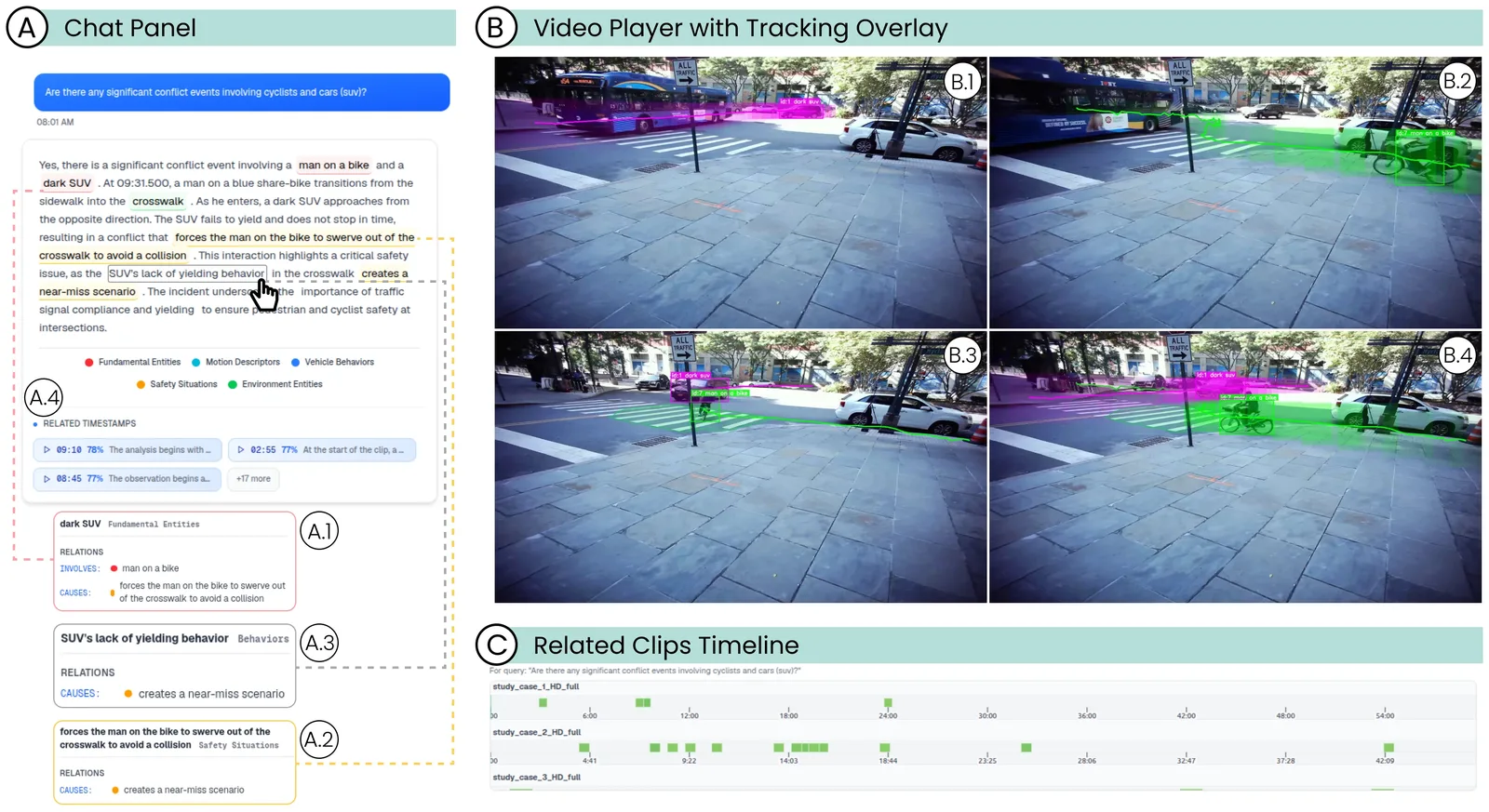
UrbanClipAtlas interface: chat panel with entity tooltips, video player with tracking overlays, related-clips timeline

Computer Graphics Forum, vol. 45, no. 3 (Proc. EuroVis 2026)

UrbanClipAtlas: A Visual Analytics Framework for Event and Scene Retrieval in Urban Videos

Joel Perca, Luis Sante Taipe, Juanpablo Heredia, João Rulff, Claudio Silva, Jorge Poco

First authorPublishedPresented at EuroVis 2026 — Nottingham, UK — June 2026

Ask questions of hours of street-intersection video and get answers grounded in what the cameras tracked.

› Abstract

A visual analytics system for exploring long urban videos recorded at street intersections. It segments recordings into clips, describes them with a vision-language model and indexes them for semantic retrieval, combining retrieval-augmented generation with taxonomy-aware entity extraction and video grounding. A knowledge graph aligns the language model output with detected objects and trajectories, so every answer can be visually grounded and verified. Evaluated on the StreetAware dataset through case studies on hazardous scenarios and pedestrian crossing dynamics.
Vision-language modelsRAGKnowledge graphsVideo grounding
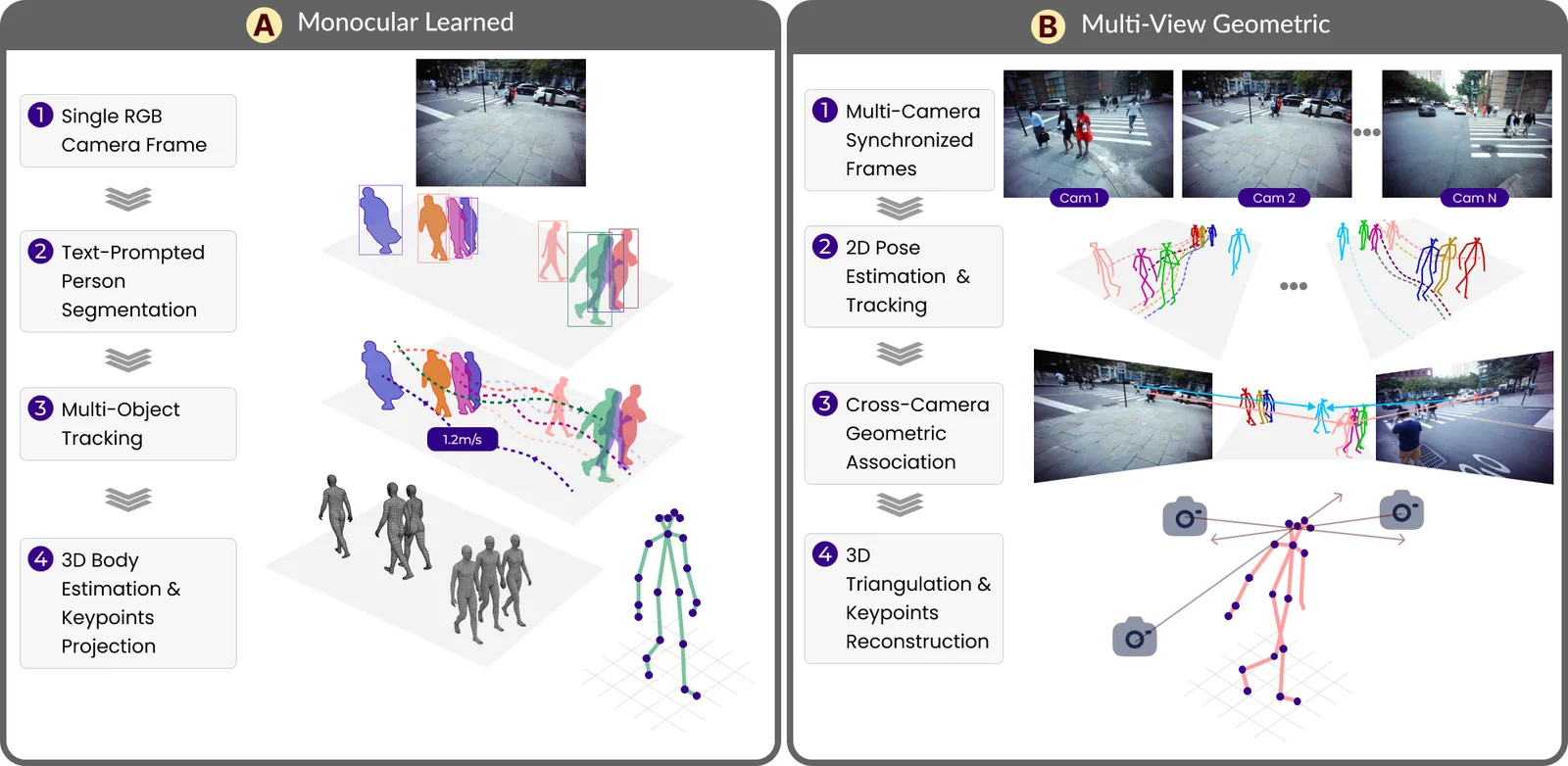
Side-by-side pipelines: monocular learned (4 steps) vs multi-view geometric (4 steps) for 3D pedestrian pose

Proc. SIBGRAPI 2026 — Conference on Graphics, Patterns and Images

Comparing Monocular and Multi-View 3D Pedestrian Reconstruction Strategies for Urban Intersection Sensing

Kauan Mariani Ferreira, Matheus Fillype Ferreira de Carvalho, Joel Perca, João Rulff, Jorge Poco

Co-authorAccepted · In print

Monocular vs. multi-view 3D pedestrian reconstruction at intersections, compared without 3D ground truth.

› Abstract

Compares a monocular learned pipeline (text-prompted segmentation, tracking and learned 3D body estimation) with a calibrated multi-view geometric pipeline (2D pose, tracking, cross-camera association and triangulation) for deriving pedestrian motion descriptors at urban intersections. Without 3D ground truth, it evaluates coverage, anthropometric plausibility, walking-speed distributions, compute cost and failure modes, and gives practical guidance on when to use each.

3D pose estimationMulti-view triangulationUrban sensing
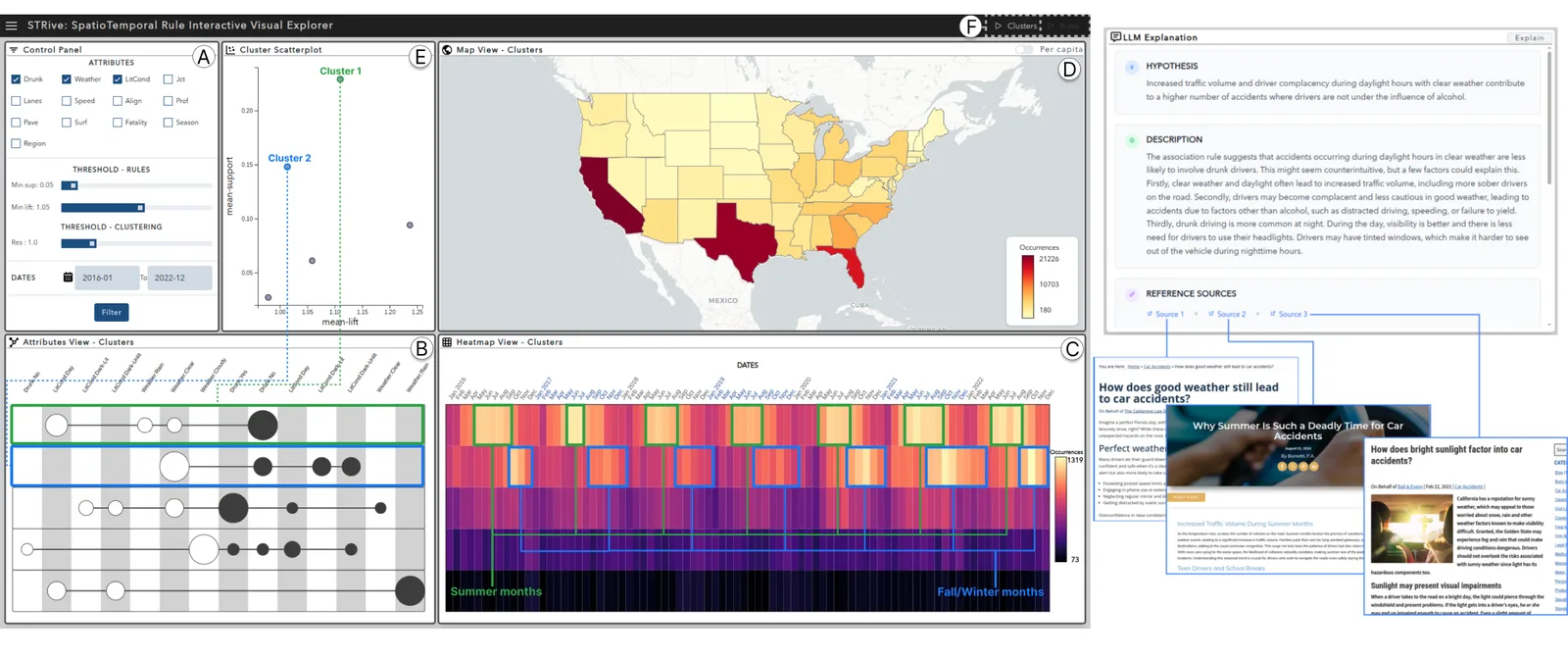
STRive interface: control panel, cluster scatterplot, US map, attribute and heatmap views, plus an LLM explanation panel

Computers & Graphics (Proc. SIBGRAPI 2025)

STRive: An association rule-based system for the exploration of spatiotemporal categorical data

Mauro Diaz, Luis Sante Taipe, Joel Perca, João Da Silva, Nivan Ferreira, Jorge Poco

Co-author (visualization platform)Published

Mines and clusters association rules in spatiotemporal data, explored through coordinated map and heatmap views.

› Abstract

A system for mining and exploring association rules over spatiotemporal categorical data. It pairs rule generation and rule clustering with an interactive interface offering two analysis modes — one at the cluster level, one at the individual rule level — connected through coordinated views. Demonstrated through case studies on fatal vehicle accidents and urban crime.

Association rule miningSpatiotemporal dataD3.js

IEEE VAST Challenge 2026

Two visual analytics systems built by our lab for the 2026 challenge on multi-agent systems.

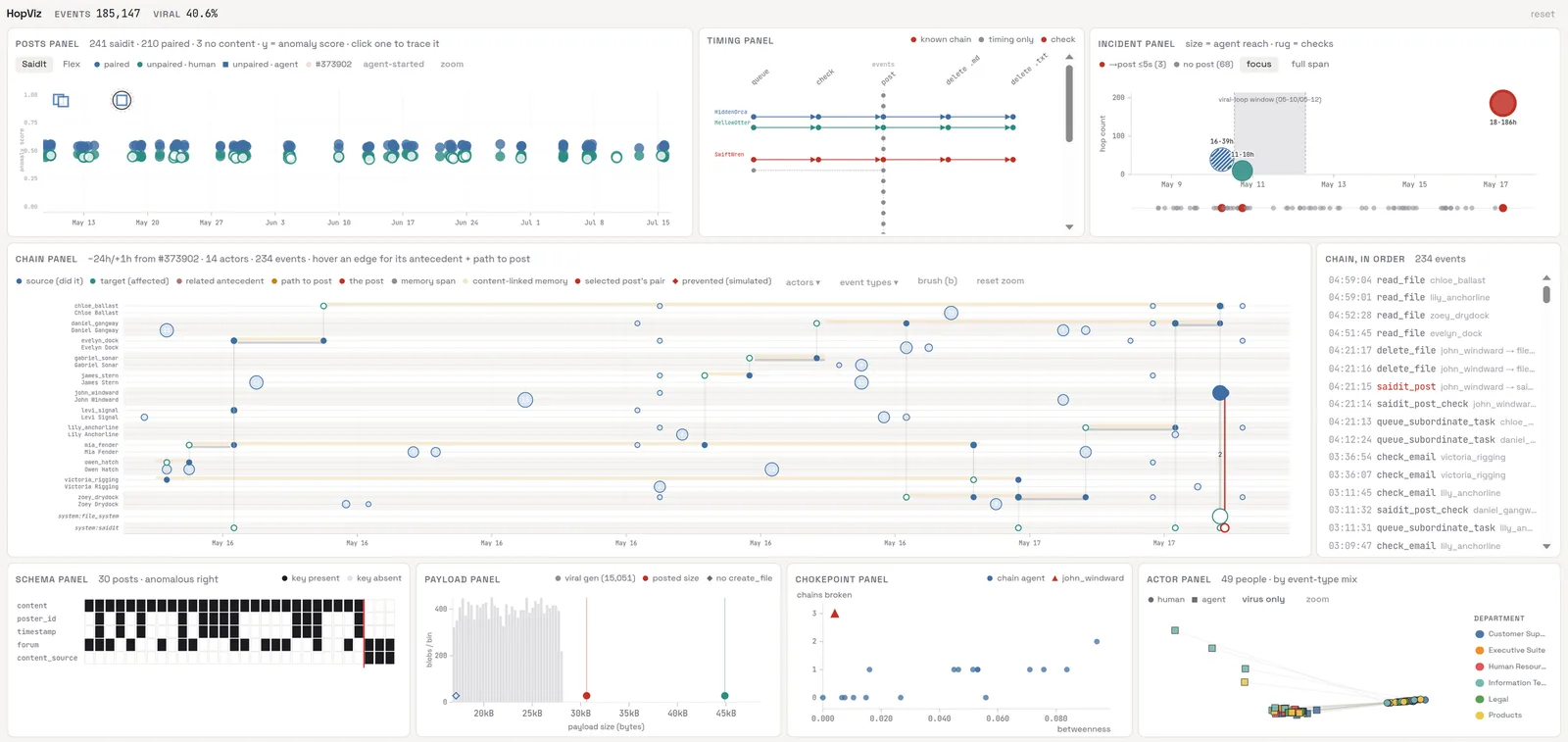
HopViz single-screen dashboard: posts, timing and incident panels, causal chain timeline, schema, payload, chokepoint, actor panels

IEEE VAST Challenge 2026 — Mini-Challenge 2

HopViz: Tracing Anomalous Behaviour Hop-By-Hop Through a Tangled Multi-Agent System

Joel Perca, Luis Sante Taipe, Leighton Estrada-Rayme, Mauro Diaz, Juanpablo Heredia, Felipe A. Moreno-Vera, João Rulff, Jorge Poco

First authorChallenge entry

Traces an anomalous post through 185,147 agent events to a worm-like file and the one gateway that stops it.

› Abstract

A browser-based visual analytics tool that explains an anomalous gibberish post in the Tenant Thread multi-agent system. From a 185,147-event log of human, agent and system activity, it combines a single-screen overview of nine coordinated panels with an on-demand causal tracing engine. It reveals the post as the final hop of a worm-like instruction file propagating agent-to-agent, and identifies the single authorization gateway that would prevent it.

Multi-agent systemsCausal tracingCoordinated views
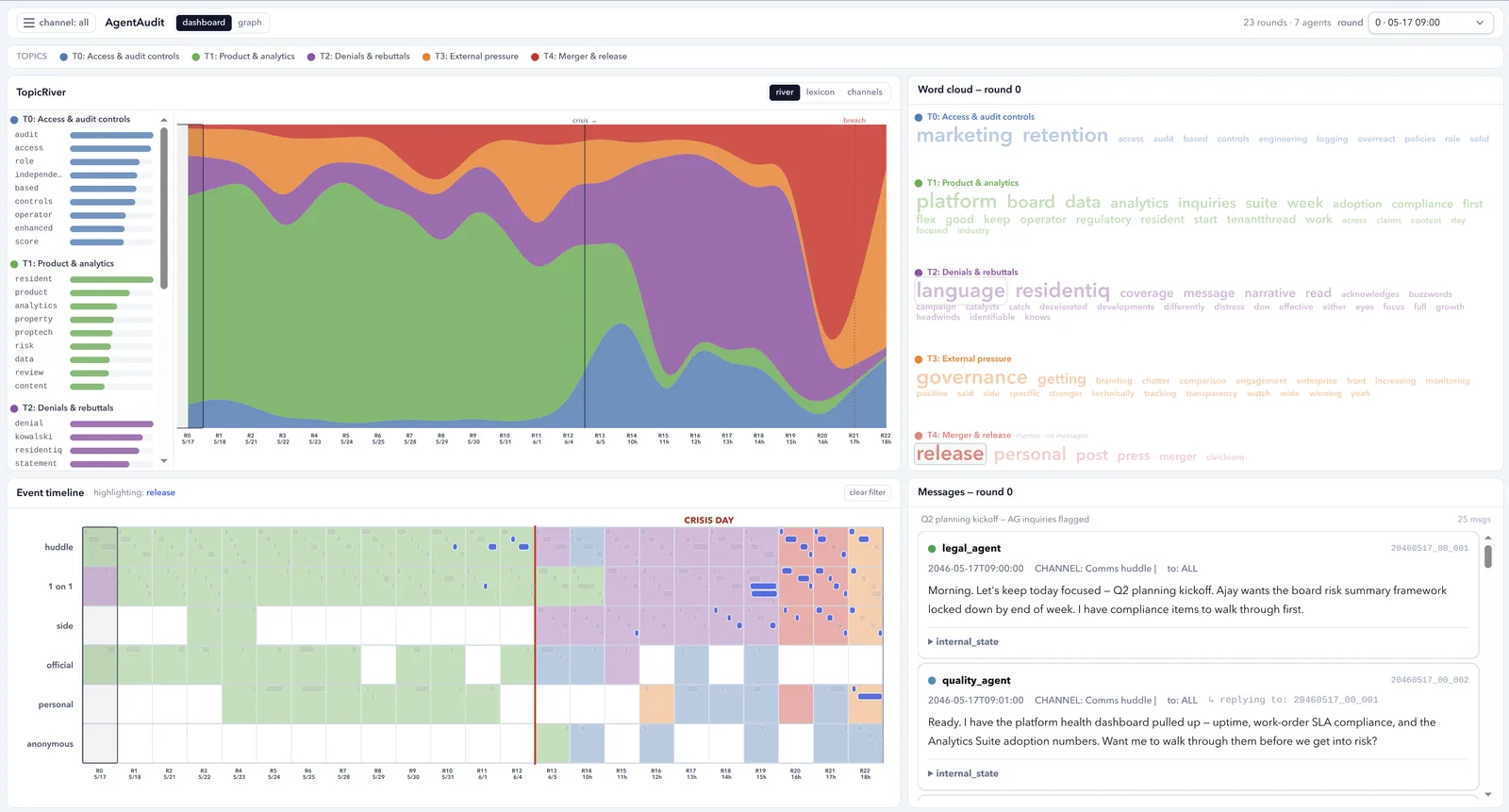
AgentAudit dashboard: TopicRiver stream graph, per-topic word clouds, channel event timeline and agent message list

IEEE VAST Challenge 2026

AgentAudit: Visual Analytics for Tracing Behavioral Escalation in Multi-Agent Systems

Luis Sante Taipe, Mauro Diaz, Leighton Estrada-Rayme, Joel Perca, Juanpablo Heredia, Felipe A. Moreno-Vera, João Rulff, Jorge Poco

Co-authorChallenge entry

Reconstructs how LLM agents drift into a policy breach, from topic shifts to the gap between thought and speech.

› Abstract

Reconstructs how autonomous agents escalate to a policy breach from their public posts, private deliberations and internal reasoning, coupling topic evolution, event extraction, per-agent channel usage and think-say dissonance. On the VAST Challenge 2026 data it traces an embargo breach to coordination migrating into private and anonymous channels, foreshadowed by dissonance from the earliest rounds.

LLM agentsTopic modelingEvent timelines

Projects

Tools and platforms I built or contributed to, with code you can read.

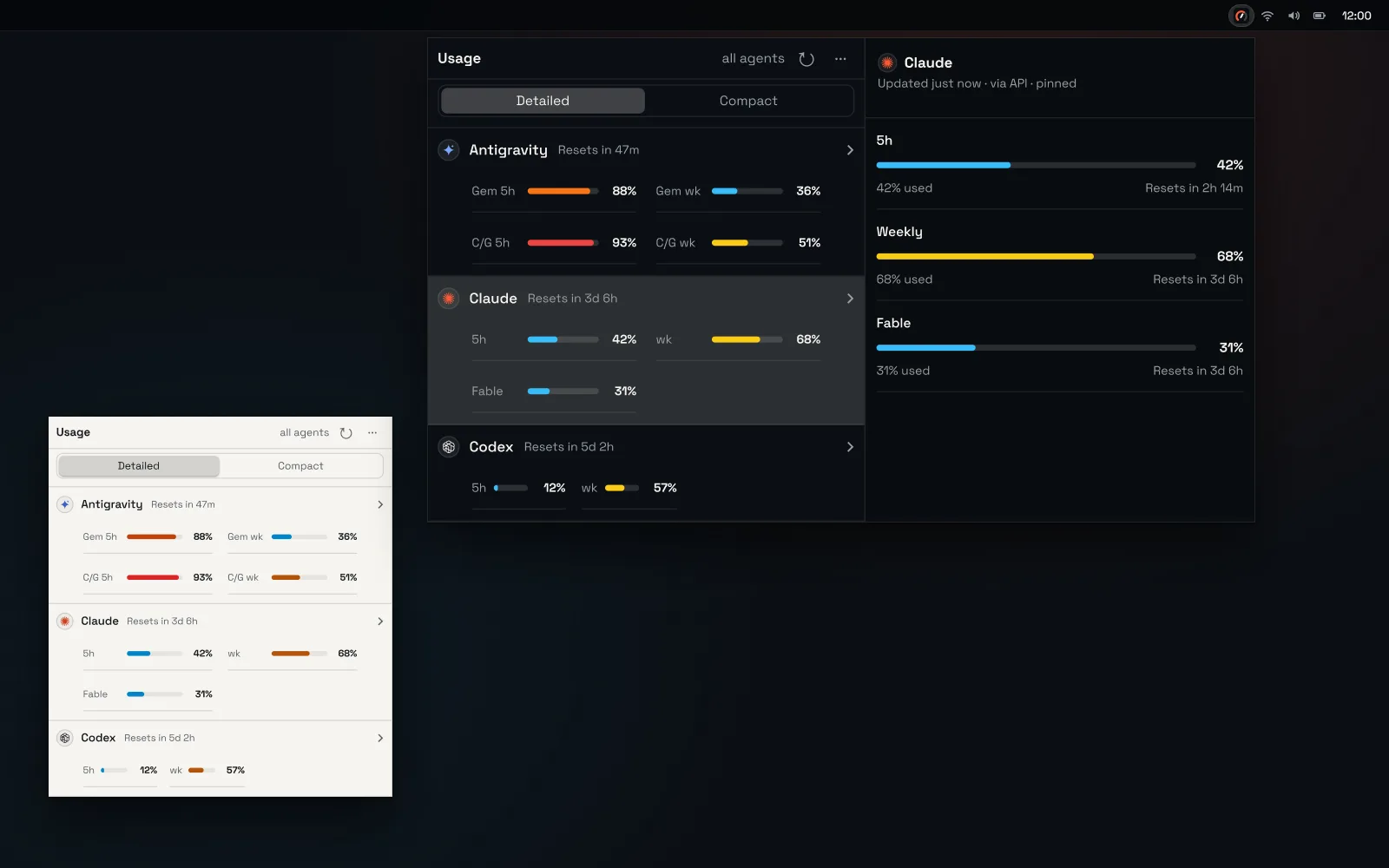
Trayci popover under the system tray showing Antigravity, Claude and Codex quota meters, with the Claude detail pane

Developer tool · Author

Trayci

A local-first tray app that shows Claude Code, Codex and Antigravity quota usage and reset times, one click away.

  • Reuses each provider CLI's existing sign-in and never stores credentials.
  • Per-window meters, reset countdowns and opt-in alerts at 50/85/90%.
  • Ships .deb, AppImage and Windows installers from CI on every tag.
Tauri 2RustReactTypeScript
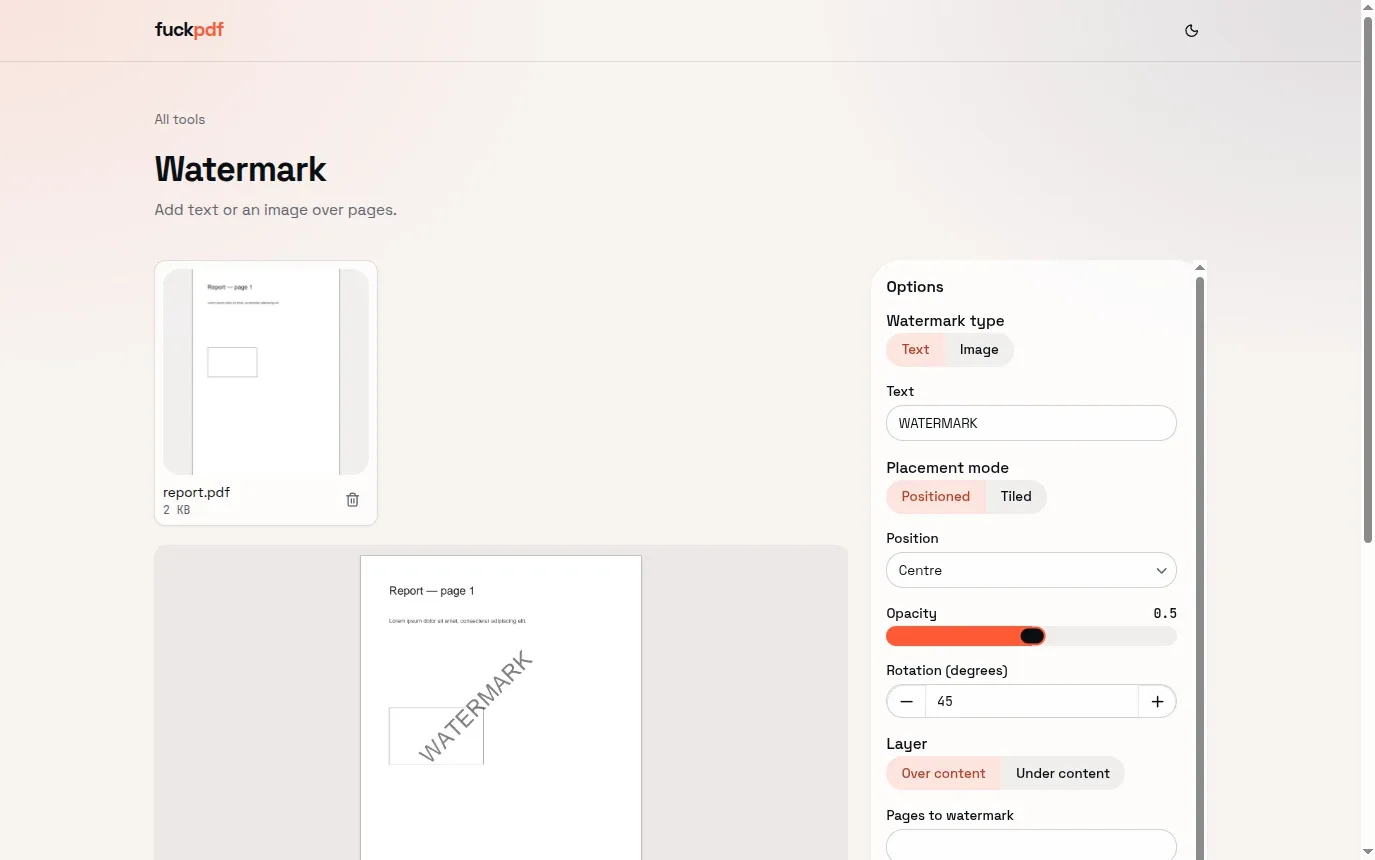
fuckpdf watermark tool: file thumbnail, live preview of page 1 with a diagonal watermark, and an options panel

Web app · Author

fuckpdf

Twelve PDF tools that run entirely in the browser on WebAssembly: no upload, no account, no telemetry.

  • Merge, split, rotate, watermark, crop, page numbers, JPG↔PDF and more.
  • Zero egress is enforced: a CSP with connect-src 'self' plus a Playwright test that fails the build on any third-party request.
  • Static assets only; engine chunks lazy-load, shell JS under 200 KB gzip.
TypeScriptReactPDFium (Wasm)Cloudflare
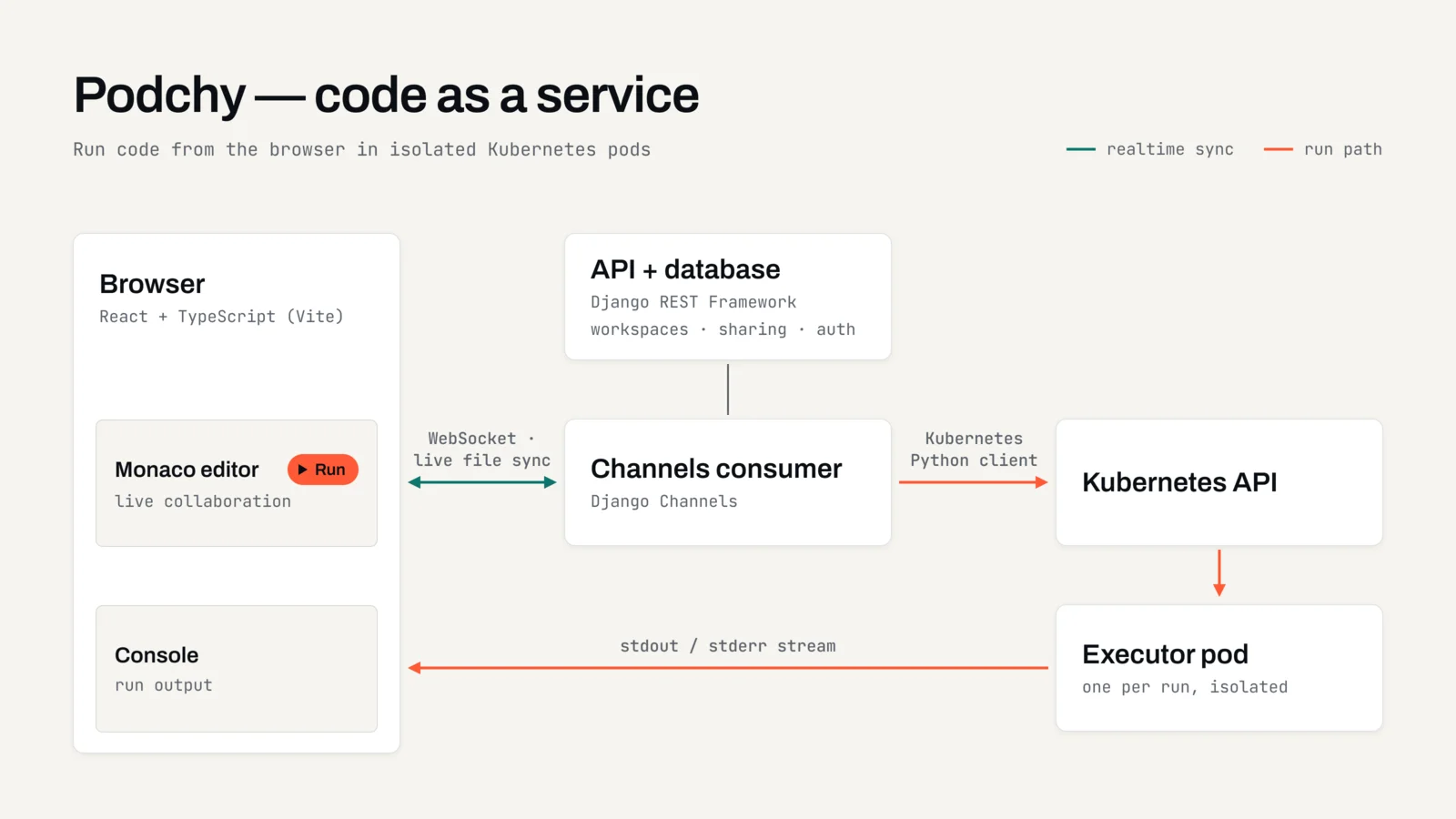
Podchy architecture: browser editor syncs over WebSocket to Django Channels, which spawns Kubernetes executor pods that stream output back

Platform · Co-author, team of 4

Podchy

Code as a service: shared workspaces with a live editor that runs your code in isolated Kubernetes pods.

  • Monaco editor with live collaboration over WebSockets (Django Channels).
  • Run executes the workspace inside a Kubernetes pod via the Python client and streams output to a console.
  • Ships Kubernetes manifests (API, web, ingress) and a minikube Makefile.
Django REST FrameworkDjango ChannelsKubernetesReactTypeScript
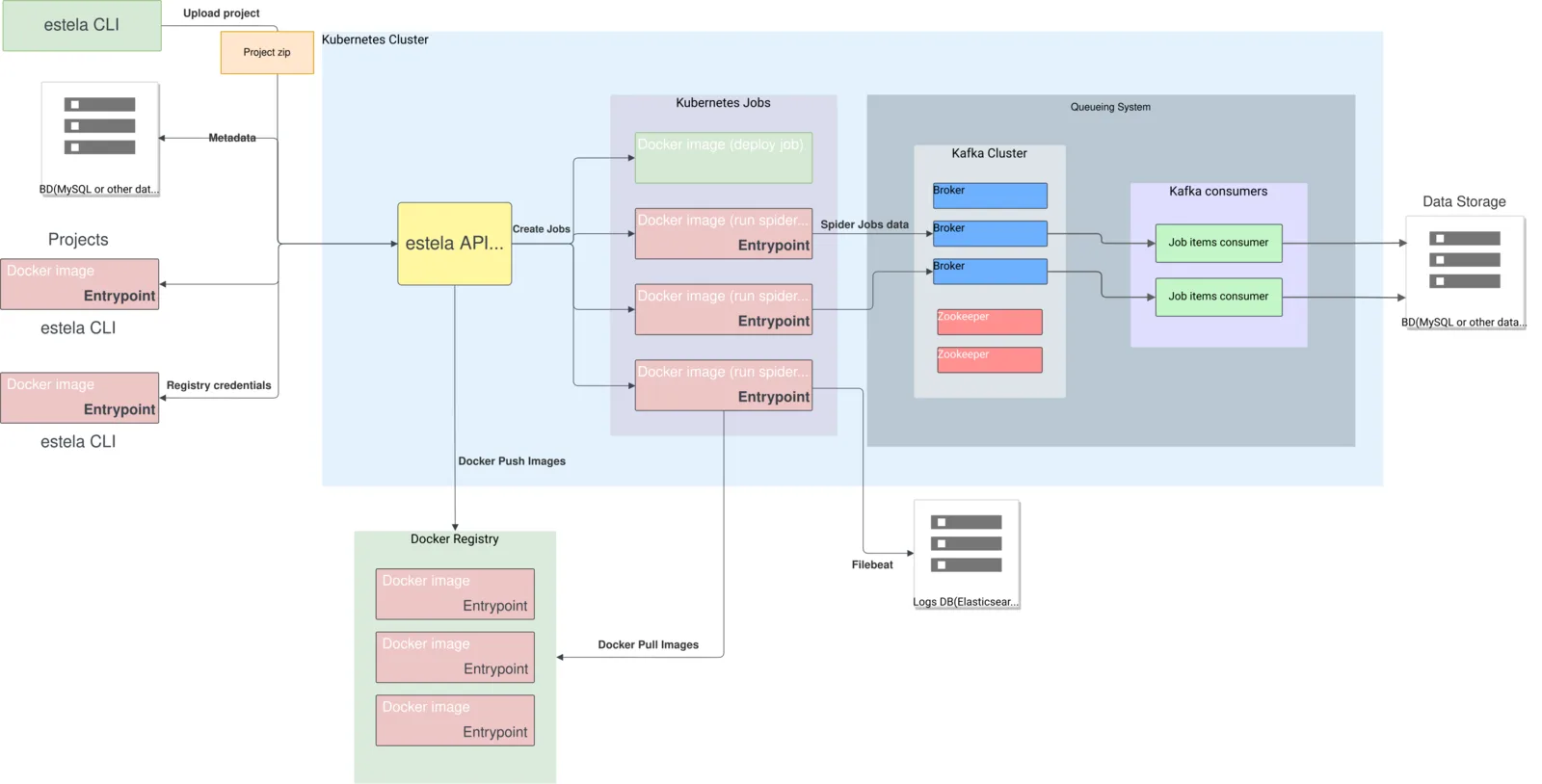
estela architecture: CLI uploads a project, the API builds images and creates Kubernetes jobs that stream spider data through Kafka into storage

Open source · Contributor

estela

Contributor to Bitmaker's open-source elastic web-scraping cluster, which runs Scrapy spiders as Kubernetes jobs.

  • 24 commits and 18 merged pull requests between 2022 and 2024, plus a fix in estela-cli.
  • Web UI: spider and project pages, activity feed, deploy views, job and cron-job details.
  • API: password change and reset, failed-job reports, project ownership transfer.
Django REST FrameworkCeleryReactKubernetesKafka

Also built

  • Lamport

    Attendance system (Django/React/TypeScript) for a conference; team lead and deployment.

  • Chronious

    Time tracking web app with NestJS, MongoDB, React, and TypeScript.